ARTICLES
Japanese Tattoo History and Iconography: What the Symbols Actually Mean
Koi aren't just fish. Dragons aren't just dragons. Japanese tattooing has centuries of visual language behind it: here's what it means and how to work with it.
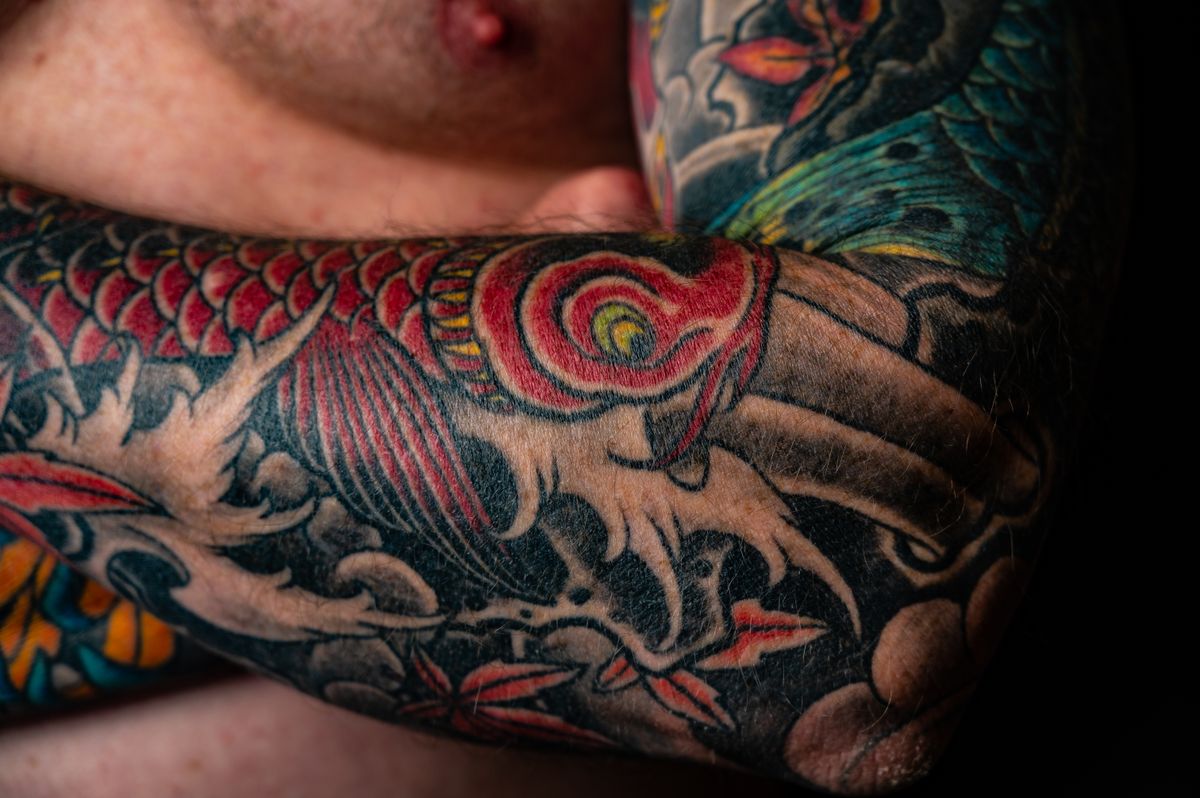
TL;DR: Japanese tattooing, irezumi, is one of the oldest and most compositionally rigorous tattoo traditions on earth. The imagery isn't decorative. Koi mean perseverance. Dragons aren't evil. Tigers hold back the wind. Every motif plugs into a symbolic system refined over centuries. If you're planning a Japanese piece, knowing what you're putting on your body changes everything about the consultation, the placement, and the result.
You've seen the work. Full sleeves wrapped in waves and wind bars, a koi pushing upstream through negative space, a dragon coiling around a forearm like it owns the anatomy. There's a reason Japanese tattooing stops people cold.
It's not just the scale. It's not even the technique, though tebori and a proper hand with a machine both hit different. What separates Japanese tattooing from almost every other tradition is this: the imagery was designed for a moving body, not a flat canvas. The composition breathes with the muscle. The waves follow the arm. The wind bars follow the ribs. Nothing sits flat.
That's the thing collectors come to understand eventually. Japanese tattoo history isn't background information. It's the reason the work looks the way it does, and it's the lens you need before you book the session.
A Brief History of Irezumi
The short version: irezumi has roots going back thousands of years in Japan: pottery evidence from the Jōmon period (14,000–300 BCE) shows figures with markings. But the tradition that feeds modern Japanese tattooing came together during the Edo period (1603–1868).
Woodblock printing was everywhere in Edo-period Japan. Ukiyo-e artists like Utagawa Kuniyoshi were producing prints of tattooed heroes: characters from Chinese novels like Suikoden, inked with dragons and tigers and demons. Tattooers started translating that visual language directly onto skin. The bold outlines, the flat color fills, the layered shading: it all traces back to woodblock aesthetics. The Smithsonian's collection of Edo-period woodblock prints makes this lineage obvious.
Then came the criminal associations. The Tokugawa shogunate used tattoo marks as punishment. Criminals got inked as social branding: visible, permanent, public. When irezumi got adopted by laborers, gamblers, and yakuza as a counter-identity, the Japanese government banned decorative tattooing outright in 1868 to present a modernized face to the West. The ban wasn't lifted until 1948, after the US occupation.
Those decades of illegality pushed the tradition underground, but didn't kill it. It made it more insular. More codified. When the revival hit and Western collectors started flying to Japan in the '70s and '80s to sit under masters like Horiyoshi III, the tradition came back into global view intact.
Today irezumi sits at a crossroads: deeply respected, widely imitated, occasionally misunderstood. The visual grammar is still there if you know how to read it.
Core Iconography: What the Motifs Actually Mean
Japanese tattooing has a visual vocabulary. These aren't random images. Each motif carries meaning, and the combinations matter too.
Koi and Perseverance
Koi swimming upstream is one of the most direct symbols in the tradition. It comes from a Chinese legend: koi that successfully swim upstream and pass through the Dragon Gate transform into dragons. The meaning is perseverance, ambition, the push against adversity.
Direction matters. A koi swimming upstream signals struggle and determination. Swimming downstream can represent having achieved the goal, or accepting fate. Ask your artist about this before you lock in composition.
Color carries meaning too. Red and orange koi traditionally represent love and bravery. Black koi are linked to successfully overcoming obstacles. Gold koi are associated with wealth and prosperity. Not every artist sticks to that system strictly, but traditional practitioners will.
Dragons
Japanese dragons, ryū, are nothing like their Western counterparts. They're not malevolent. They're not fire-breathers hoarding gold. They're water deities. Creatures of rivers, lakes, seas. They're benevolent, powerful, and associated with wisdom, protection, and good fortune.
That's why a dragon wrapping a bodysuit doesn't read as threatening: it reads as blessed. The claws, the whiskers, the horns all have their own details. Three-clawed dragons are typically associated with Japan; five-clawed with China. A knowledgeable artist knows the difference.
Tigers
Tigers in Japanese iconography are the counterpart to dragons. Where dragons rule water and the heavens, tigers rule the earth. Together they represent the balance of opposing forces. Tigers are also connected to the north wind: a tiger tattooed facing downward is said to hold the wind back.
Compositionally, a tiger in a Japanese piece almost always involves bamboo and wind bars. It's not decorative filler. That's the correct iconographic context.
Peonies
Botan, the peony, is the king of flowers in Japanese tradition. It represents wealth, honor, and elegance. In tattooing it often appears as a background element behind figures, or filling space in a sleeve. But "filler" undersells it. Peonies in irezumi are bold, structural, and fully rendered. They're not passive.
They also carry a tougher edge: because beauty is temporary, peonies can represent taking risks, embracing life fully knowing it ends. A peony next to a skull or hourglass leans into that interpretation.
Waves and Water
Hokusai's Great Wave didn't come from nowhere. Water is everywhere in Japanese art because it represents both life force and impermanence: two central ideas in Buddhist thought. In tattooing, waves aren't background texture. They're compositional infrastructure.
Waves follow the body. A properly designed set of water elements wraps around curves, rises and falls with the anatomy. That's the craft. The British Museum's collection of Hokusai prints shows how water composition worked in the original source material, and why tattooers who studied those prints built work that flows completely differently from artists who just reference Instagram.
Oni
Oni are demons. But in Japanese folklore they're complicated: they punish the wicked, they protect temples, they show up at New Year's to drive out evil spirits. They're scary and sacred simultaneously.
An oni piece isn't a flex of darkness. It's closer to a guardian figure. Red oni and blue oni are separate archetypes with distinct personalities. The iron club, kanabō, is the characteristic weapon. A good artist will know these details without being told.
Phoenix
The hō-ō (Japanese phoenix) is rebirth and resurrection. It appears only in times of peace, according to the mythology, and represents virtue and grace. In tattoo terms it's often chosen by people who've been through serious transformation: it earns that symbolism. As a design element, the tail feathers give massive compositional opportunity, especially on backpieces or full sleeves.
Tebori vs Machine
Tebori is the traditional hand-poking method: a wooden or metal handle with needles attached, worked into the skin by hand. It's slower. It produces a softer, more diffused look in the shading, particularly visible in the grey washes. Some collectors swear they can see the difference in healed work; the research on whether the healing quality is genuinely different is less clear-cut than the internet debates suggest.
What's undeniable: tebori is significantly more intense. The physical sensation is different. Practitioners who actually train in tebori, not just people who learned it as a novelty, have spent serious time with the technique. It's not a gimmick. It's a full discipline.
If tebori matters to you for a Japanese piece, it needs to be a search criterion, not an afterthought. Most Western artists offering "hand poke" work are not the same as practitioners trained in traditional tebori. Those are different skill sets.
Finding an Artist Who Actually Knows This Tradition
This is where collectors get burned. Japanese tattooing has a recognizable aesthetic, bold outlines, wave elements, a few stock motifs, and plenty of artists produce work that looks Japanese from a distance without understanding the compositional rules that make it actually work.
Red flags to watch for when vetting:
- Portfolio shows Japanese motifs mixed without regard for their traditional pairings or symbolic weight
- Compositions don't adapt to the body: they look like they were designed on flat paper
- Artist can't answer basic questions about what motifs they're using or why they're paired
- Flash-heavy approach with no discussion of how a piece will integrate with existing work or future plans
What you want instead: an artist who talks about the body first. Who asks where the piece is going before they discuss what's in it. Who understands that a Japanese bodysuit is built over years with a coherent compositional logic, not assembled from disconnected flash over multiple sessions.
Check the Tatulogue style guide for a broader breakdown of how Japanese work sits within the wider tattoo style landscape, useful context before you start hunting.
Find Japanese tattoo specialists on Tatulogue: filter by style, browse real portfolio work, and see who's actually operating in the tradition.
What a Proper Consultation Looks Like
A good consultation for a Japanese piece is a real conversation, not a quick booking call.
Expect the artist to ask about long-term plans. Are you building toward a sleeve? A bodysuit? Or is this a standalone piece? Japanese tattooing is designed as a system. One session should leave room for what comes next, even if you never book that next session.
Bring reference for the motifs you're drawn to, but hold it loosely. A traditional artist is going to adapt to your body, your existing work, and the compositional rules of the tradition. If you hand them a screenshot and say "exactly this," you're not doing a Japanese tattoo: you're doing a copy. Those are different things.
Ask about their source material. Are they referencing historical woodblocks, prints, established masters? Or are they going off Pinterest? The answer tells you a lot. See the artist vetting guide at Tatulogue for the full checklist of what a real consultation should cover.
Discuss scale honestly. Japanese tattooing doesn't work small in the traditional sense. The linework is heavy, the fills are dense, the compositions are designed to read at bodysuit scale. Miniaturizing the style usually kills what makes it work. A good artist will tell you this directly.
The Takeaway
Japanese tattoo history is the foundation for everything you see in the work. When you know that the koi means perseverance, that the dragon is a water deity, that the tiger and dragon in the same piece are two halves of a cosmological balance: you're not just collecting ink. You're wearing a visual language.
That changes the conversation with your artist. It changes what you ask for and how you evaluate the work. The tradition is rigorous. The best practitioners take it seriously. Go in prepared.
If you want to stay current on Japanese tattooing, artist spotlights, and style breakdowns, subscribe to the Tatulogue newsletter at tatulogue.com. And if you're supporting independent tattoo culture content, check out the Tatulogue Kickstarter.
FAQ
What is the difference between irezumi and a Japanese-style tattoo?
Irezumi specifically refers to the traditional Japanese tattooing practice: the techniques, the iconographic system, the compositional approach developed in Japan over centuries, particularly through the Edo period. A "Japanese-style tattoo" is a broader term that includes work by Western artists working in that aesthetic. The quality and depth of knowledge varies enormously. Irezumi, practiced by trained traditional artists, is not the same thing as someone doing Japanese-influenced flash.
Does the direction a koi swims actually matter?
Yes, in traditional iconography it does. A koi swimming upstream represents active struggle and determination toward a goal: the dragon gate legend. Downstream can represent completion or acceptance of fate. Not every artist applies this strictly, but if you're working with a traditionally trained artist or someone serious about the iconography, it will come up in the consultation. Worth asking directly.
What's the significance of waves in Japanese tattooing: are they just background filler?
Waves are compositional structure, not filler. They come from a visual tradition rooted in ukiyo-e printmaking: Hokusai's water studies are the direct source material. In a bodysuit or sleeve, waves follow the body's contours and provide compositional flow between motifs. They also carry symbolic weight around impermanence and life force in Buddhist tradition. A good wave composition is one of the hardest things to execute properly.
Is tebori better than machine for Japanese tattooing?
It depends on what you mean by "better." Tebori produces a characteristically soft diffusion in the shading that practitioners argue is unique to the technique. But a skilled artist working with a machine can produce exceptional Japanese work. What matters more is whether the artist genuinely understands the tradition. Tebori done poorly produces inconsistent results; machine work done by an artist with deep knowledge of irezumi produces serious, lasting pieces. Don't choose tebori as a status symbol: choose it if you've found an artist who actually trains in it.
How do I know if an artist is actually trained in Japanese tattooing versus just using the aesthetic?
Look at how they talk about composition before they talk about imagery. A traditionally informed artist will ask about your body, your long-term plans, and what exists already before they discuss motifs. They should be able to speak to the symbolic weight of what they're proposing. If they can't explain why they'd pair specific elements together, or if the portfolio shows motifs used without regard for their traditional pairings and compositional logic, that's a surface-level approach. Search for Japanese specialists on Tatulogue and spend time in portfolios before you book.