ARTICLES
Why You Shouldn't Bring an AI Generated Tattoo Design to Your Artist
AI generated tattoo designs look sharp on a screen and fall apart on skin. Here's why the gap between a prompt and a real tattoo is bigger than it looks, and what to bring instead.
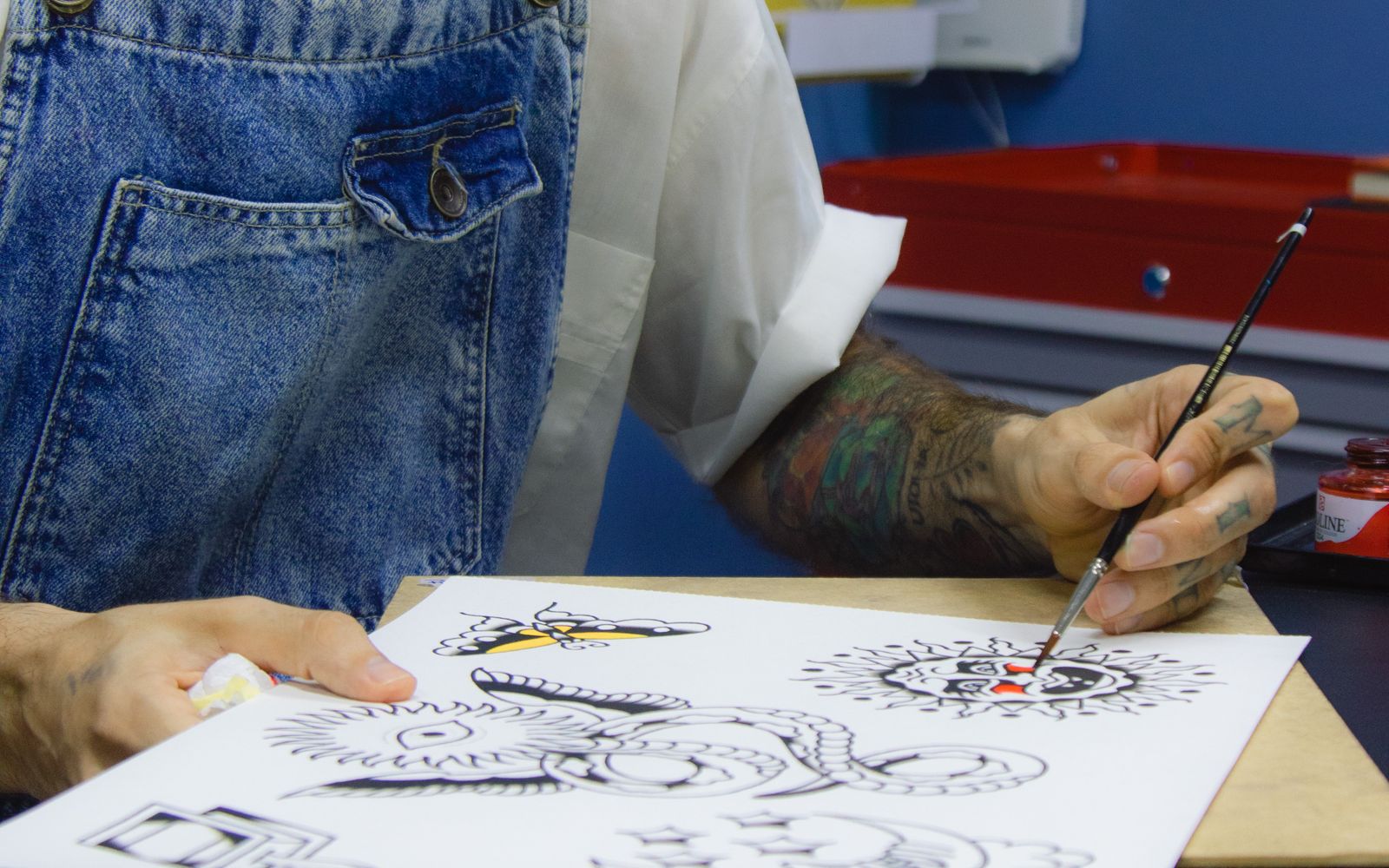
TL;DR: AI generated tattoo designs produce images that look sharp on a screen and fall apart on skin. Too much detail, no understanding of how ink spreads and fades, and no read on how a design actually sits on a moving body. Artists know all three. Here's why that gap matters, and what to bring instead.
Someone walks into a consultation with a phone out, an AI generated tattoo design pulled up, and an expectation that the artist just tattoos it. Exactly as shown. No changes. The artist looks at it for two seconds and already knows it's not happening the way the client thinks.
That scene is playing out in shops more and more. The image looks finished, confident, even impressive at first glance. But a picture generated from a text prompt was never built for skin. It was built to look good on a screen for half a second before you scroll past it, and that's a completely different job than surviving twenty years on a forearm.
This isn't an anti-technology rant. It's about understanding why an AI generated tattoo design and an actual tattoo are two different objects that happen to look similar in a thumbnail. It's also part of why Tatulogue built this platform without VC money or AI shortcuts in the first place: the craft doesn't need a generator standing in for the artist.
Why Do AI-Generated Tattoos Look Bad in Real Skin?
AI tools generate images optimized for a flat digital canvas, not a curved, moving, healing surface. They pile in fine detail, inconsistent line weight, and gradients that photograph well but have no translation into how a tattoo machine actually deposits ink. The result heals into a blurry mess within a few years, sometimes within months.
Skin isn't paper. A machine can't lay down a soft AI-generated gradient the way a printer lays down ink on a page. Every line has to be built with a needle, at a consistent depth, in saturation levels that scar tissue can actually hold onto. AI has no concept of any of that because it's never made a single mark on a human body.
That gap shows up fast on tiny detail work especially. A lot of AI output crams in delicate shading and thread-thin lines that read as gorgeous at 1200 pixels wide and turn to mush the second real skin, real swelling, and real years get involved. Bold holds. Delicate blurs. AI doesn't know the difference because it's never watched a piece heal.
AI Doesn't Know What It Doesn't Know About Tattooing
A generated design has no read on placement, no read on body flow, and no idea how a design needs to bend, stretch, and compress as it wraps a real limb. It was never shown a moving body. It was shown a dataset of flat images and asked to remix them into something new.
Good custom work accounts for the client's actual anatomy: how a design sits across a shoulder that moves, how it reads when an arm bends at the elbow, how it ages as skin loosens over decades. None of that lives inside a prompt. It lives inside an artist who has drawn on hundreds of different bodies and watched how ink settles into each one.
There's also the small matter of originality. AI models are trained on scraped tattoo photography, meaning an "AI generated tattoo design" is frequently a soft-blended remix of some tattooer's actual portfolio, run through a system with zero attribution and zero understanding of the linework decisions that made the original piece work in the first place.
Composition is another blind spot. A tattoo has to work as a single continuous piece once it's inked, not as a collage of separate elements floating near each other. AI output regularly ignores that: mismatched perspective on different parts of the same design, shading that shifts direction for no reason, proportions that only make sense because the model never had to commit to a single light source or a single anatomical reference. An artist catches every one of those problems before a needle ever touches skin. A generator has no idea they exist.
What Tattoo Artists Are Actually Saying About AI Right Now
The reaction inside the industry has been loud and mostly unimpressed. Working tattooers describe AI-generated reference images as unusable without heavy manual correction, and some shops have started flatly refusing to tattoo a design pulled straight from a generator. Several artists interviewed by Stories and Ink describe spending more time fixing an AI reference than they would have spent just drawing the piece from scratch.
Other artists have gone further and treated it as a threat to the craft itself. A tattooer profiled by KFYR-TV started publicly calling out clients who brought in AI mockups, arguing it undercuts the years artists spend building an actual hand for linework and shading.
Not everyone's fully against it, though. Some artists use AI loosely for early mood-boarding, the same way they'd use a Pinterest board, then throw the actual generated image away once real sketching starts. Euronews covered this middle-ground use among a small group of tattooers, but even there, the AI output never touches skin directly. It's inspiration, not a blueprint.
If you're not sure how an artist you're eyeing feels about AI references, ask before the consultation. It tells you a lot, and it lines up with the broader how to vet a tattoo artist approach: you're not just checking their portfolio, you're checking how they think about the work.
The Environmental Cost Nobody Mentions
Every AI-generated image carries a real energy and water cost, and most people bringing a generated design to a consultation have no idea. A single image generation can use as much electricity as charging a phone, and training the underlying models consumes water and power at a scale most casual users never see.
MIT News broke down the actual footprint of generative AI tools, and the numbers aren't small once you multiply a single prompt across the millions of people generating throwaway images daily. A UN University estimate put global AI-related water consumption in the billions of liters annually, a lot of it burned on images nobody keeps past a few scrolls.
For a permanent piece you're going to wear for the rest of your life, running dozens of throwaway prompts to land on a "good enough" reference is a strange trade. A shop sketch pad and thirty minutes with an artist gets you further, and costs nothing but time.
What to Bring Your Artist Instead
Bring references, not finished designs. Photos of healed work in the style you want, placement examples on bodies shaped like yours, a Pinterest board of things you're drawn to even if none of them are exactly right. That's raw material an artist can actually build with.
Say the quiet part out loud too: tell the artist what you want the piece to feel like, not just look like. Bold and graphic. Soft and delicate. Mean-looking. Sentimental. That kind of direction gives a real tattooer more to work with than a hyper-detailed AI mockup that falls apart the second they try to translate it into a stencil.
And trust the process. A good consultation is a conversation, not a hand-off. The first tattoo guide covers this in more depth if you're newer to booking: the artist's job is to take loose ideas and turn them into something that holds, not to trace an image you found in twelve seconds.
If you're set on something highly specific, sketch it yourself even if you can't draw well. A rough stick-figure version of a placement idea, arrows pointing at what should be bigger or smaller, notes scrawled in the margins: that tells an artist more about your actual intent than a polished AI image ever will, because it shows your thinking instead of hiding it behind a generator's guesswork. Artists are used to working from rough notes. It's most of the job.
Here's the actual takeaway: an AI generated tattoo design is a mockup of a mockup, built by a system that has never seen a tattoo heal. It can spark an idea. It cannot replace the years an artist spent learning how ink actually behaves in skin. Bring the feeling, bring the references, let the person holding the machine do what they've trained to do.
If you want more breakdowns like this dropped straight to you, the Tatulogue newsletter at tatulogue.com covers exactly this kind of stuff: what's actually happening in tattoo culture, not just what shows up in your feed. And if you're new here, check out the Tatulogue Kickstarter to see what we're building for collectors and artists alike.
FAQ
Can a tattoo artist just tattoo an AI generated design exactly as shown? Technically yes, but most won't recommend it. AI images are built for screens, not skin, so an artist typically has to redraw the linework, simplify detail, and adjust proportions before it's tattoo-ready.
Why do AI generated tattoo designs blur or fade faster than custom work? They're often packed with fine detail and soft gradients that a tattoo machine can't replicate at a saturation level skin can hold long-term. That detail collapses into a blurry mass once the piece heals and ages.
Is it okay to use AI for tattoo inspiration only? Some artists are fine with AI images used loosely as mood-board material, similar to a Pinterest reference, as long as the actual tattoo gets redrawn by hand. Always ask your artist their stance before the consultation.
What should I bring to a consultation instead of an AI mockup? Real reference photos, examples of healed work in the style you want, and a clear sense of the feeling you're after. Let the artist translate that into an actual design.
Does generating AI tattoo images have an environmental cost? Yes. Each generation uses real electricity and water, and running many prompts to land on one usable reference adds up fast for something as permanent as a tattoo.